
Exploring Detroit & Windsor Through Stories: A Collaboration With Buried In Print Part. 3 (The Finale!)
As you’ve seen on my blog I love traveling to new places within the pages of a book. Buried in Print and I became connected through the world of book blogging years ago and have become friends through our love of books and snail mail! We often chat about our connection through our hometowns and she came up with the brilliant idea of a reading project that bridges Detroit, Michigan (USA) and Windsor, Ontario (Canada) through books set in those locations.
My Windsor Book Pick:
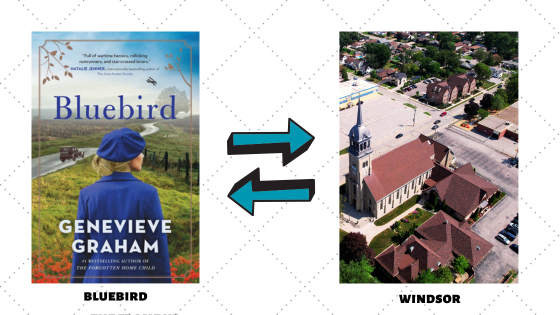
Present day :Cassie Simmons, a museum curator, is enthusiastic about solving mysteries from the past, and she has a personal interest in the history of the rumrunners who ferried illegal booze across the Detroit River during Prohibition. So when a cache of whisky labeled Bailey Brothers’ Best is unearthed during a local home renovation, Cassie hopes to find the answers she’s been searching for about the legendary family of bootleggers…
1918: Corporal Jeremiah Bailey of the 1st Canadian Tunnelling Company is tasked with planting mines in the tunnels beneath enemy trenches. After Jerry is badly wounded in an explosion, he finds himself in a Belgium field hospital under the care of Adele Savard, one of Canada’s nursing sisters, nicknamed “Bluebirds” for their blue gowns and white caps. As Jerry recovers, he forms a strong connection with Adele, who is from a place near his hometown of Windsor, along the Detroit River. In the midst of war, she’s a welcome reminder of home, and when Jerry is sent back to the front, he can only hope that he’ll see his bluebird again.
By war’s end, both Jerry and Adele return home to Windsor, scarred by the horrors of what they endured overseas. When they cross paths one day, they have a chance to start over. But the city is in the grip of Prohibition, which brings exciting opportunities as well as new dangerous conflicts that threaten to destroy everything they have fought for.
My Thoughts:
Bluebird is a novel set during the Great War and postwar Prohibition that mixes elements of romance, suspense, and drama. I have read a lot of books about the Prohibition era before, but never one that focused on Canada and the dangerous job of the rum running business from that era. It was fascinating to read all of the history packed into this novel and all of the new things I learned from reading it. Especially how it delves into the aftermath of World War I and how veterans as well as citizens were reeling from the tragedies of wartime. It is especially evident in the main couple featured in this romance how war shaped their lives for the rest of their exsistence and how they run into constant reminders of their time abroad. It’s heartbreaking, emotional, and just shows the devestation that comes with the price of freedom.
Graham does an excellent job of greating two timelines of the past and present throughout this novel. The time shifts are done smoothly and gives greater context to how history makes its presence known. Epescially when it comes to Cassie’s modern day timeline and trying to see out the secrets of her family’s past. Cassie, along with the main leading characters, Jerry and Adele are well written characters who keep the reader engaged till the very end. I think this novel was such a great read overall and I am interested to read more of her historical fiction going forward. Bluebird does a fantastic job of capturing the resilient spirit of women in wartime.
Here are some interesting facts I found out about the Great War/Prohibtion era that tied into the novel:
- Prohibition was first enacted on a provincial basis in Prince Edward Island in 1901. It became law in the remaining provinces — as well as in Yukon and in Newfoundland (which did not join Confederation until 1949) — during the First World War.
- Unlike in the United States, banning booze in Canada was complicated by the shared jurisdiction over alcohol-related laws between Ottawa and the provinces.
- One way to drink legally was to be “ill,” since doctors could give prescriptions to be filled at drugstores.
- By constitutional amendment, the United States was under even stricter prohibition from 1920 to 1933 than was Canada. The manufacture, sale, and transportation of all beer, wines, and spirits were forbidden there.
- Francis Pegahmagabow, from the Shawanaga Nation, joined the Canadian Army in 1914. For his combat prowess and bravery during the war, he was awarded the Military Medal three times, making him the most decorated member of the First Nations in Canadian military history.
- Considered the unsung heroes of WW1, the Canadian Railway Troops (CRT) consisted of pre-war railway workers who built and maintained the rail network to ferry supplies and men across the Western Front’s British sector.
- In recognition for its significant contribution to the Allied war effort on the Western Front, Canada was granted a separate seat at the 1919 Treaty of Versailles by the UK, alongside other dominions including Australia, New Zealand and South Africa. By giving Ottawa greater autonomy in the conduct of foreign affairs, this development put Canada on a gradual path towards full independence, which would be achieved following WW2.
Reading Project Overview
I’ve done Buddy Reads before since I started blogging years ago, but this is the first time I did a reading project. Buried In Print and I are always discussing various types of literature through our platforms and also with each other. We often chat about each other’s hometowns and through this reading project it adds to the overall power of books and how it brings us together. Though Windsor and Detroit are across the borders from each other (and in two different countries) we often share a lot of history together. Not only does the Detroit river connect us, but the close proximity means that we both have vistors from each city constantly coming back and forth.
For those who aren’t familiar with the areas, The Ambassador Bridge is a suspension bridge connecting Detroit, Michigan, and Windsor, Ontario, which opened in 1929 after being privately funded and constructed between 1927 and 1929. It was the world’s largest suspension bridge at the time of its completion, symbolizing the peaceful relationship between the U.S. and Canada. It also remains the busiest international border crossing in North America for trade. People are often atonished at how close we are to each other, and being a local (from the Detroit side) it’s something I never really thought about until I grew up.
What I took away from this reading project as a whole is that these “sister cities” have such a resilient spirit especially in times of trouble. Though both books were set in completely different time periods, I can see how even tenacious the cities are at innovation, growth, and creating a community for its residents. It’s one of the reasons I’m so fiercely defensive of my hometown. I learned a lot about our histories and differences between Canadian and American culture.
To read about Buried In Print’s reflections on our reading project, visit her website here: http://www.buriedinprint.com/cross-border-reading-detroit-and-windsor-through-stories/
I hope we can do another reading project going forward in 2026 and in the meantime, I’ll be seeking out more novels from Windsor writers.



What a great idea, to summarise in point-form what you learned about Canadian history from just one book! (And, wow, GG really packed a lot into her romance.) Something your review made me think about, in relationship to my Detroit-choice, was the idea of how the characters in all these books seem to be fundamentally impacted by the decisions made by politicians (in local government, but also federal government, and even global politics given that your historical novel was set when the idea of empire and imperialism was even more prominent in society) but the story lives with how individuals navigate that in their personal lives, so the stories are very relable and we feel connected to the characters above all else. I loved reading cross-border with you, and Detroit/MI stories will forever be changed for me now!
I definitely learned a lot. There are some musuems in Detroit that do cover bits of Canadian history, but this one is cohesive and taught me a lot about that era Graham focuses on. I also agree about politcal effects and how it even translates into the city structures now. I had so much fun reading with you and hopefully we can do another project in the future. You’ve inspired me to see out more Canadian writers.